
Mature Project: The Great Unbundling
As Debug80 reached maturity, it faced a classic architectural crossroads. We started with a simple debugger and quickly added support for the TEC-1 platform. ROM loaders and example games like Caverns followed. The repository was becoming a "mono-blob" that cluttered the codebase with machine-specific binary data and logic. To ensure the long-term stability of the core debugger, I initiated what I called "The Great Unbundling."
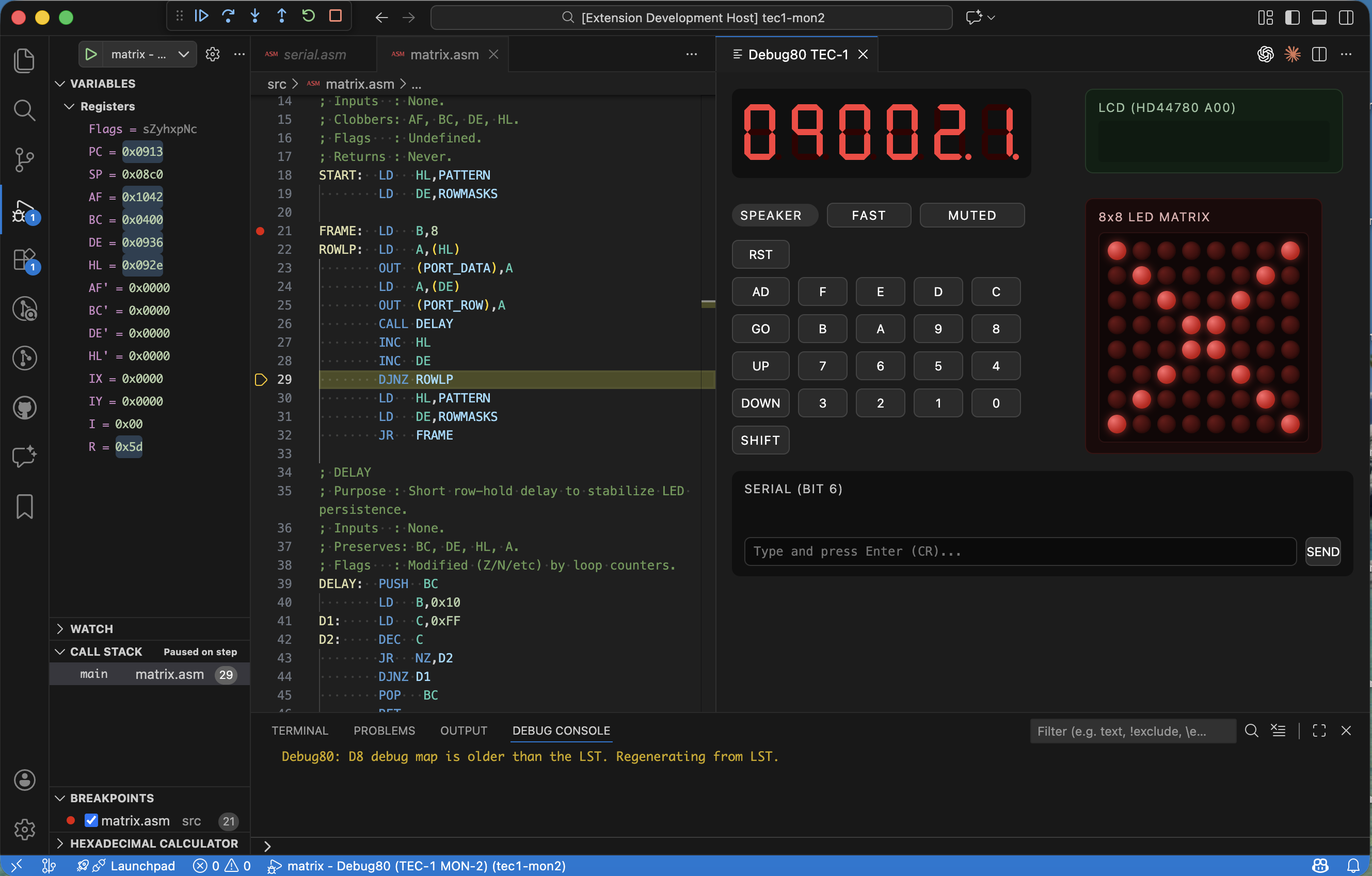
This capture shows the interface state that framed the unbundling work.
Identifying the Core
The core of Debug80 is the VS Code Debug Adapter Protocol (DAP) implementation plus the Z80 emulator. I treat everything beyond that as peripheral. That peripheral layer includes the TEC-1 ROMs and its RAM initialization files. Scalability meant that a developer should be able to use Debug80 for any Z80 project without the core repository needing to know about that project's specifics.
The Role of debug80.json
The bridge between the generic core and the specific platform is the debug80.json configuration file. Instead of hardcoding platform memory details in the TypeScript source, I moved them into a declarative per-project configuration. This shift allowed the debug80 repository to delete several hundred kilobytes of binary ROM data and machine-specific code.
Decoupling the Ecosystem
With the core now generic, specific platforms can live in their own repositories. debug80-tec1 contains the TEC-1 specific monitor code and configuration templates. caverns80 owns its game logic and assembly organization. When a developer wants to debug a new machine, they don't need to submit a PR to the main Debug80 repo. They create a new repository and include debug80 as a tool, along with their own debug80.json.